
In recent years, Karnataka’s Kalaburagi district has transcended its regional identity to emerge as a significant center of national political discourse. The reason behind this remarkable transformation is a rare and historic development—leaders from the same district ascending to the topmost positions of two different national political parties. This is not just a proud moment for Kalaburagi, but for the entire state of Karnataka.
On one hand, Mallikarjun Kharge has been elected as the National President of the Indian National Congress, one of the oldest and most influential political parties in the country. On the other, Shivalingappa Kinnur has risen as the National President of the Rashtriya Samaj Party, a voice representing socially conscious and grassroots politics. Together, these achievements have positioned Kalaburagi as a powerful hub of national leadership.
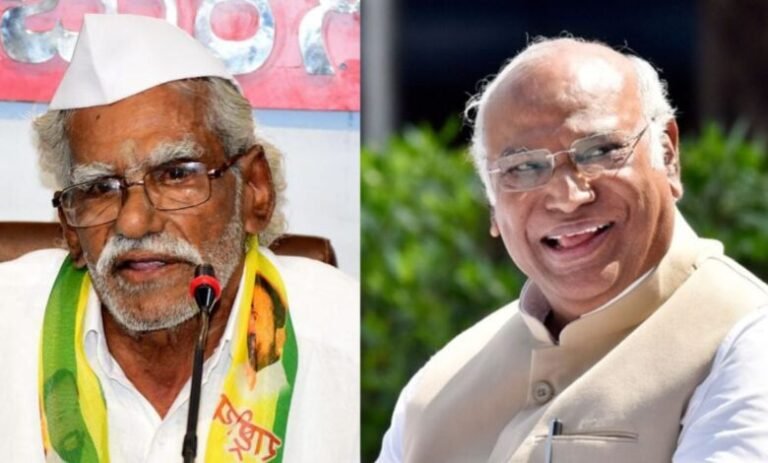
Mallikarjun Kharge’s journey reflects decades of political experience, a commanding voice in Parliament, and an unwavering commitment to social justice. From humble beginnings in Kalaburagi to leading a national party, his rise serves as a beacon of inspiration for countless young individuals in the region.
Similarly, Shivalingappa Kinnur’s emergence as a national leader symbolizes the strength of grassroots movements and people-centric politics. Known for his steadfast advocacy for workers, marginalized communities, and the underprivileged, Kinnur’s leadership reinforces the idea that value-based politics still has a vital place in the democratic framework.
This is not merely the story of two individuals-it is a reflection of Kalaburagi’s socio-political consciousness, its rich legacy of movements, and its enduring spirit of resistance and reform. Historically known as a land of activism and social awakening, the district has now reached a stage where it contributes to shaping the direction of national politics.
Though they represent different political ideologies, both leaders share a common foundation—commitment to social justice, equality, democratic values, and the rights of marginalized communities. This shared ethos is what makes Kalaburagi politically unique.
Shivalingappa Kinnur: From Social Struggles to National Leadership
Social transformation is never achieved through words alone—it demands sacrifice, resilience, and relentless struggle. Shivalingappa Kinnur stands as a living embodiment of this truth. After decades of dedication to social justice, he has now earned the honor of serving as the National President of the Rashtriya Samaj Party.
Rooted in rural realities and deeply connected to the lives of working people, Kinnur’s journey is anything but ordinary. Instead of remaining silent in the face of inequality and injustice, he chose to question, challenge, and act—making it his life’s mission.
His engagement has gone beyond political platforms into active participation in social movements, spreading awareness and mobilizing people at the grassroots level. His vision has always centered on ensuring dignity, representation, and justice for backward classes, laborers, and neglected communities. This vision is not just reflected in his words, but in the path he has walked.
Under his leadership, the Rashtriya Samaj Party has gained renewed direction and discipline. His approach blends organizational strength with ideological clarity and a deep sense of service. His direct connection with grassroots workers, responsiveness to public issues, and preference for service over power have made him a leader of the people.
Power and position have not altered his character—simplicity remains his greatest strength. Even today, he is seen among the people as one of them, which is the foundation of the trust he enjoys.
Future Expectations and Aspirations
With national responsibilities now on his shoulders, expectations from Shivalingappa Kinnur have naturally grown. There is a collective hope that he will further strengthen the fight for social justice, equality, and the rights of working communities.
Kalaburagi is no longer just a district—it is now a symbol of leadership emerging onto the national stage. This historic moment is one that its people can celebrate with immense pride.
With hopes that the struggle for social justice grows stronger and that the nation’s politics finds a renewed direction, this moment marks not just an achievement—but the beginning of a larger transformation.

