
- Landmark agreement signed to strengthen government school education across Karnataka
Bengaluru, August 21:
Karnataka has achieved a major milestone in its public education reform journey with the signing of an agreement between the Government of Karnataka and the Asian Development Bank (ADB) for the comprehensive development of 500 government schools as Karnataka Public Schools (KPS).
The programme has a total investment of ₹2,500 crore, of which ₹1,750 crore will be provided by ADB and ₹750 crore by the State Government. The programme will be implemented over four years, up to 2029-30.
The agreement was signed at Vidhana Soudha in the presence of Chief Minister Shri D.K. Shivakumar, Deputy Chief Minister Dr. G. Parameshwara and School Education and Literacy Minister Shri Madhu Bangarappa, along with senior officials of the Government of Karnataka and ADB.
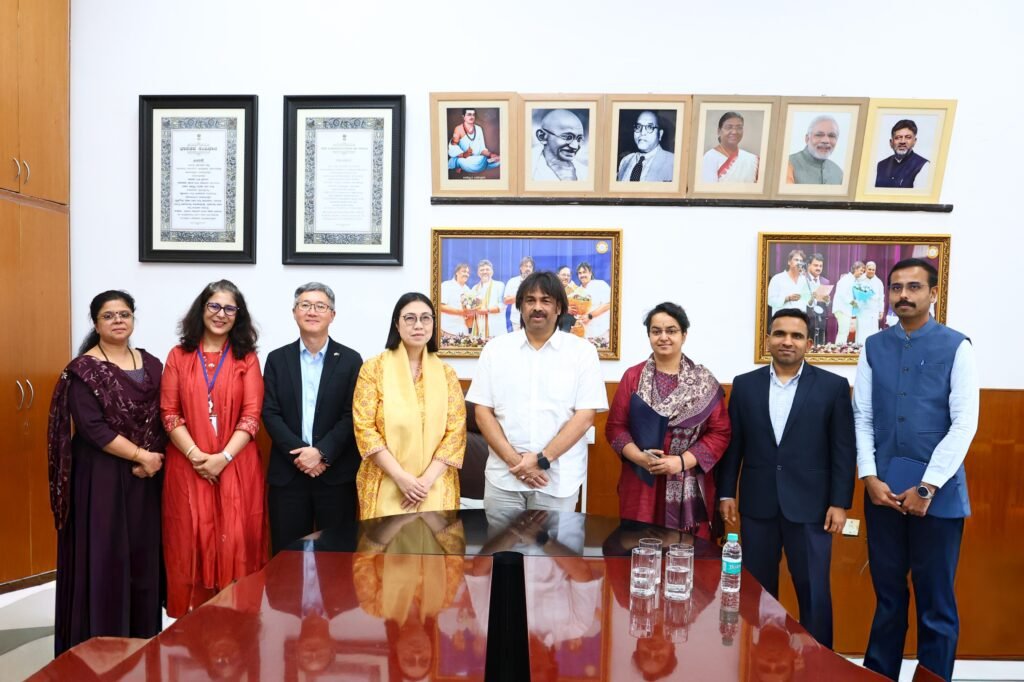
A significant achievement for Karnataka’s education reforms
The agreement is an important outcome of the sustained efforts of the School Education and Literacy Department under the leadership of Minister Madhu Bangarappa to strengthen government schools and establish Karnataka Public Schools as comprehensive institutions offering quality education from pre-primary to Grade 12.
Minister Madhu Bangarappa said that extensive discussions were held with senior ADB officials before the agreement was finalised. The bank examined Karnataka’s KPS programme, the measures undertaken by the department and the state’s commitment to improving the quality of government education.
500 schools with capacity for at least 1,200 students
Under the programme, 500 identified schools across all educational districts will be developed as comprehensive KPS institutions. Schools with the potential to attract large numbers of students have been selected based on parameters including grade coverage, enrolment, land availability and infrastructure. Each selected school is targeted to have the capacity to accommodate at least 1,200 students.
As part of the school-complex integration process, potential schools have already been identified in clusters and nearby sub-scale schools within a 3–5 km radius have been mapped for possible consolidation. Around 100 Detailed Project Reports (DPRs) have already been prepared.
Eight Education Guarantees at the heart of the programme
The KPS programme will implement the Government’s eight Education Guarantees aimed at improving access, quality and learning outcomes in government schools. These include the appointment of 15,000 new teachers, including specialised Computer Teachers; bilingual education; free transportation facilities currently under planning; computer education from Grade 1 and Artificial Intelligence education from Grade 3; dedicated teachers for Art, Physical Education and other specialised subjects; separate staff for non-academic responsibilities; stronger systems for monitoring learning and educational quality; and practical skill education along with targeted preparation for competitive examinations.
The department has already taken significant steps in these areas, including teacher recruitment, continuous teacher training, preparations for AI education, recruitment of Computer Science teachers, the Nirantara student attendance initiative, vocational and skill education and planning for safe transportation for rural students.
Results-based programme with nine indicators
The ADB-supported KPS programme will be implemented under the Results-Based Lending (RBL) model and is linked to nine Disbursement-Linked Indicators (DLIs). The indicators focus on improving Grade 8 proficiency in English, mathematics, science and social science, improving the transition from Grade 10 to Grade 11, increasing the percentage of female students passing Grade 12 examinations, and establishing 500 safe, inclusive, gender-responsive and climate-resilient KPS schools.
The framework also seeks to strengthen the professional capacity of teachers and school leaders, expand STEAM education, enhance the state’s CSAS assessment system, improve students’ employability and 21st-century competencies, and strengthen the efficiency and transparency of CSR partnerships.
The nine DLIs together account for USD 208 million, representing 100 per cent of the ADB financing allocation, with disbursement linked to achievement of agreed results.
₹1,750 crore ADB assistance over the programme period
The ADB financing is structured across the programme period. ₹262.5 crore (15 per cent) is associated with prior results for 2025-26. The scheduled assistance is ₹358.75 crore (20.5 per cent) in 2026-27, ₹385 crore (22 per cent) in 2027-28, ₹376.25 crore (21.5 per cent) in 2028-29 and ₹367.5 crore (21 per cent) in 2029-30, taking the total ADB assistance to ₹1,750 crore.
The investment will cover civil works and infrastructure development, classroom furniture, laboratory equipment, IT infrastructure and other facilities. Recurring expenditure will include teacher salaries, non-teaching staff, transport, administration, utilities, maintenance and other school-level operational requirements.
Training and capacity building will cover the 500 KPS schools and 3,635 secondary and higher secondary schools, with programmes in subject knowledge, blended learning, STEAM, Learning Enhancement Plans, assessment design, school leadership and gender-sensitive counselling.
The programme will also support digital content and learning assets, career guidance cells, technical clubs and exposure visits, besides establishing a state-level Programme Management Unit (PMU) for implementation support and technical interventions.
Building the next generation of Karnataka’s public schools
The KPS programme brings together infrastructure development, teacher recruitment, professional development, bilingual education, digital and AI learning, STEAM, vocational skills, assessment reform, career guidance, transportation and stronger school governance within one integrated framework.
The signing of the ADB agreement marks a major step in converting Karnataka’s KPS vision into a large-scale, results-based programme. With 500 schools, ₹2,500 crore in total investment and ₹1,750 crore in ADB assistance, the programme provides Karnataka with a strong financial and institutional framework to accelerate the transformation of government school education.
School Education and Literacy Minister Shri Madhu Bangarappa expressed his appreciation to Chief Minister Shri D.K. Shivakumar, Deputy Chief Minister Dr. G. Parameshwara and the leadership of the State Government for their support in advancing this major education initiative.

